Shiny: The Next Disaster
Terin Hopkins, Manager of Public Fire Protection
The fire protection community has no shortage of important issues competing for its attention. If anything, the list continues to grow. Every year seems to bring a new hazard, a new technology, a new fire, or a new lesson that demands immediate attention.
The problem is not that we focus on these emerging issues. The problem is that we too often move-on before finishing the work already in front of us.
A significant fire occurs, and for a period of time everyone is focused. Investigations begin. Code changes are proposed. Committees are formed. Research is funded. Conferences are built around the subject. Articles are written, presentations are delivered, and everyone agrees that something must be done.
Then the next issue arrives.
Attention shifts. Funding shifts. Conversations shift. The previous concern slowly moves further down the agenda, even though the underlying hazard may remain largely unchanged. It is the fire protection version of chasing the next shiny object.
At the National High-Rise Retrofit Summit, Dr. Lori Moore-Merrell made a simple observation that should stay with all of us:
“The Buildings Are Still There.”
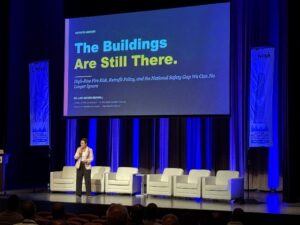
It was said in the context of existing unsprinklered high-rise buildings, but the message applies much more broadly. The hazard does not disappear simply because our attention moves somewhere else.
For generations, we have repeated the phrase that fire and building codes are “written in blood.” While dramatic, there is truth behind it. Many of the requirements found in today’s codes exist because people were injured or killed before we understood, accepted, or acted on a known hazard.
Automatic sprinklers in assembly occupancies did not become a major focus by accident. Improved egress requirements were not created in a vacuum. Standpipe systems, smoke control, fire department access, interior finish limitations, and many other provisions were strengthened because fires demonstrated what could happen when protection was inadequate.
Historically, tragedy forced change. Today, the greater concern may be whether we are willing to stay focused long enough to complete that change. Look at the issues that have commanded the fire protection community’s attention over just the past several years.
Open parking garages became a significant topic as modern vehicle construction, increased combustible loading, and changes in vehicle technology challenged long-held assumptions about how fires would behave in those structures. The code community responded. Research followed. Sprinkler requirements expanded.
Then lithium-ion batteries became the dominant conversation. 
Rightfully so. Thermal runaway, battery energy storage systems, electric vehicles, e-bikes, scooters, and consumer products have created real and evolving fire challenges. Fire departments, code officials, manufacturers, researchers, and standards organizations continue working to better understand and manage those risks.
At the same time, wildland-urban interface fires have brought enormous attention to community design, building construction, vegetation management, water supply, evacuation, and resilience.
Each of these issues deserves attention. But one should not replace another. Lithium-ion batteries did not eliminate the concerns associated with open parking garages. Wildland-urban interface fires did not make lithium-ion batteries less important.
And neither issue caused the thousands of existing high-rise buildings without complete automatic sprinkler protection to disappear.
“The Buildings Are Still There.”
High-rise retrofit is perhaps one of the clearest examples of our tendency to move from one crisis to the next. We know that older high-rise buildings present significant fire protection challenges. We have studied the problem for decades. We have investigated many major fires. We understand the benefits of automatic sprinkler protection. We have debated costs, water supplies, construction impacts, implementation schedules, and alternative approaches.
Yet in many communities, the fundamental issue remains unresolved.
The occupants are still living there.
The building is still operating.
The hazard has not gone away.
The same can be said for large public assembly occupancies, particularly bars and nightclubs.
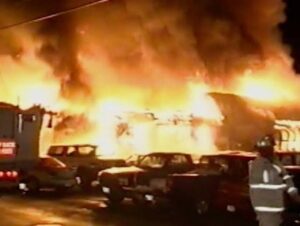 The Station nightclub fire in Rhode Island killed 100 people in 2003. The fire became one of the defining assembly occupancy tragedies of modern times and led to significant changes in codes, standards, and sprinkler requirements, but the existing unsprinklered buildings remain.
More than two decades later, the lesson should not simply be remembered as a historical event.
One hundred people died.
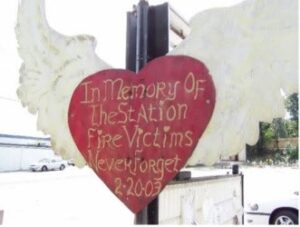 Behind every major code change is a human story like that one.
That is what can become lost when the conversation moves too quickly to the next issue. We begin talking about hazards as code sections, research projects, task groups, and technical problems. Those things are important, but they are not the reason the work matters.
The work matters because people occupy these buildings every day.
There will always be another emerging challenge.
Artificial intelligence may influence building systems. New battery chemistries will emerge. Energy storage will continue to expand. Buildings will become larger and more complex. Communities will grow further into wildfire-prone areas. New construction methods and technologies will challenge assumptions that have existed for decades.
We should study all of them, but the fire protection community also has a responsibility to maintain institutional memory. New problems should be added to our responsibilities, not used as a reason to abandon unfinished ones. Our approach to fire safety must be cumulative.
When a hazard has been identified and lives have been lost, the issue should remain on the agenda until meaningful progress has been made. That does not mean every solution will be immediate or simple. Some problems will require years of policy work, research, funding, education, and implementation. But moving on is not the same as solving the problem.
Society naturally moves toward the next headline. News cycles are short. Public attention fades. Political priorities change. Budgets shift.
The fire protection community cannot afford to operate the same way. We are supposed to remember. Open garages are still there. Unsprinklered assembly occupancies are still there. Communities exposed to wildfire are still there. Lithium-ion battery hazards are still growing.
And legacy high-rise buildings remain occupied every night.
Dr. Moore-Merrell’s words should therefore serve as more than a reminder about high-rise retrofit.
They should be a reminder of how we approach fire protection itself.
“The Buildings Are Still There.”
So are the hazards.
And if history has taught us anything, it is that ignoring a known hazard does not make it disappear. It only leaves us waiting for the next disaster to remind us why we cared in the first place.
 Terin Hopkins has 40 years of experience in public safety, fire protection, and life safety policy. He currently serves as the Manager of Public Fire Protection for the National Fire Sprinkler Association (NFSA), where he leads technical support and advocacy efforts nationwide, working closely with fire departments, code and standard, and policymakers to improve fire protection infrastructure and compliance. He represents NFSA on NFPA and UL technical committees, including NFPA 14 Standard for the Installation of Standpipe and Hose Systems.