Florida’s High-Rise Sprinkler Retrofit Program: A Roadmap for Other States
Terin Hopkins, Manager of Public Fire Protection
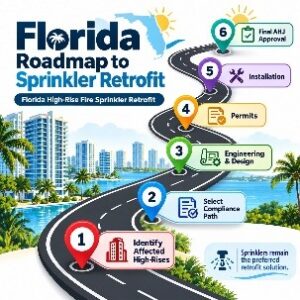 Florida provides one of the most useful examples of how a state can address older residential high-rise buildings constructed before complete automatic sprinkler protection became standard. Its approach identifies affected buildings, establishes a required level of protection, assigns responsibility, requires professional engineering and local review, and most importantly, sets enforceable milestones leading to a final completion date.
For other states considering high-rise retrofit requirements, Florida offers a strong framework. It also offers an important caution: while Florida permits an Engineered Life Safety System (ELSS) in certain existing condominium high-rises, that alternative is tightly regulated and should not be viewed as equivalent to complete automatic sprinkler protection.
Sprinklers Are the Starting Point
Florida’s current Fire Prevention Code requires affected existing high-rise apartment buildings to be protected throughout by an approved, supervised automatic sprinkler system unless they meet a specific exception. A high-rise is generally a building with an occupiable floor more than 75 feet above the lowest level of fire department vehicle access.
Florida law also requires affected residential condominium associations to comply with the Florida Fire Prevention Code and proceed with either complete sprinkler protection or, where specifically permitted, an ELSS.
The important policy point is that sprinklers remain the baseline requirement. The age of a building, difficulty of construction, or cost of retrofit does not by itself eliminate the fire-safety obligation. Instead, the code establishes a defined process for bringing the building into compliance.
Another important lesson is that ownership should not determine the level of fire protection required in a high-rise building. The fire hazard does not change because apartments are rented, individually owned as condominiums, operated as public housing, or held under another ownership arrangement. Fire does not recognize property lines, condominium documents, or whether the person occupying an apartment is an owner or tenant.
The risk should drive the requirement. Building height, construction, evacuation challenges, fire department access and operations, and existing fire protection systems are what matter. States developing retrofit requirements should therefore avoid creating substantially different levels of protection for buildings presenting essentially the same fire hazard simply because their ownership structures are different.
A Phased Approach to Compliance
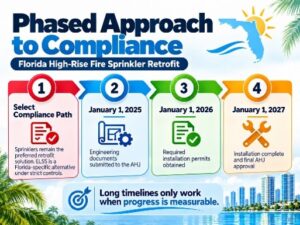
One of Florida’s strongest features is that it does not rely solely on a distant final deadline. Condominium associations were required to select their compliance method, notify the Authority Having Jurisdiction (AHJ), and then meet specific engineering, permitting, and construction milestones.
Under Florida’s current requirements, engineering documents were due by January 1, 2025, required installation permits were to be obtained by January 1, 2026, and the work must be completed and pass final AHJ inspections by January 1, 2027.
The concept of providing owners with substantial time to complete high-rise sprinkler retrofits is not new. National model fire codes have recognized a 12-year compliance concept for decades. NFPA 1 first incorporated its high-rise sprinkler retrofit provision in the 1997 edition with a 12-year compliance period. That history demonstrates that owners can be given considerable time to plan, finance, design, and phase retrofit work.
The current 2024 edition of NFPA 101 continues this approach for existing high-rise apartment buildings, establishing January 1, 2033, as the sprinkler retrofit deadline.
The purpose of a lengthy compliance period is not to wait until the final year begins. It allows owners to develop a plan, establish necessary infrastructure, coordinate work in occupied buildings, address financing, and phase installation. For states developing retrofit requirements, the lesson is straightforward: provide reasonable time but establish a firm end date and measurable progress along the way. Engineering, plan review, permitting, construction, and final approval should each have enforceable milestones.
Florida Allows ELSS but Under Strict Controls
Florida’s allowance for an Engineered Life Safety System (ELSS) should be understood as a Florida-specific provision for certain existing high-rise condominium buildings. It is not the approach provided by the current edition of NFPA 101.
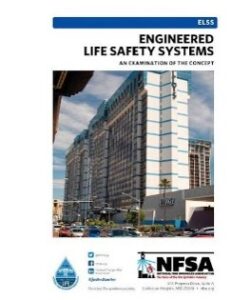 Earlier editions of NFPA 101 permitted an ELSS to be developed as an alternative to complete automatic sprinkler protection in certain existing high-rise apartment buildings. That provision was removed beginning with the 2021 edition of NFPA 101. Current NFPA 101 does not provide a prescriptive pathway for the development of a new ELSS. Instead, it recognizes ELSS installations that were “previously approved and implemented” under earlier editions of the code. A building seeking a new alternative to the prescriptive sprinkler requirement would need to address that through the code’s more rigorous performance-based design provisions.
Florida made a deliberate decision to retain an ELSS option through its state-specific amendments. As a result, Florida continues to allow qualifying existing high-rise condominium buildings to develop and install a new ELSS even though that option is no longer provided by the current national model code.
Even in Florida, an ELSS is not an informal alternative that a condominium board can assemble on its own. A Florida Registered Professional Engineer must evaluate the building and develop a building-specific design that demonstrates an equivalent level of life safety to the complete automatic sprinkler protection it replaces.
The design must show how the combined features—such as partial sprinkler protection, detection, compartmentation, smoke control, egress improvements, and other approved measures—achieve that level of safety. It must then be submitted to the Authority Having Jurisdiction (AHJ), permitted, installed, and successfully pass final inspection.
An ELSS is therefore not simply a collection of upgrades. It is an engineered alternative that must demonstrate equivalency in life safety, even though it does not provide the same fire-suppression function as complete sprinkler protection.
This distinction is important for states considering new retrofit requirements. Florida’s allowance should not be interpreted as evidence that current NFPA 101 considers a newly designed ELSS equivalent to complete sprinkler protection. Current NFPA 101 recognizes previously approved ELSS installations; Florida independently chose to continue permitting new ELSS designs through its state amendments. Complete automatic sprinkler protection remains the clearer benchmark for states developing retrofit requirements today.
The Lesson for Other States
 States developing new retrofit requirements should be cautious about creating a new ELSS option simply because Florida permits one. Automatic sprinklers address the fire where it starts and can control or suppress it before conditions extend beyond the area of origin. Other building features can improve life safety, but they do not provide that same direct fire-control function.
Florida’s greatest lesson is therefore not that states should provide two equal choices between sprinklers and ELSS. It is the value of a structured compliance process: identify the affected buildings based on risk, establish sprinklers as the benchmark, require professional engineering, provide sufficient time, establish intermediate milestones, give the AHJ clear enforcement authority, and maintain a firm final deadline.
 Terin Hopkins has 40 years of experience in public safety, fire protection, and life safety policy. He currently serves as the Manager of Public Fire Protection for the National Fire Sprinkler Association (NFSA), where he leads technical support and advocacy efforts nationwide, working closely with fire departments, code and standard, and policymakers to improve fire protection infrastructure and compliance. He represents NFSA on NFPA and UL technical committees, including NFPA 14 Standard for the Installation of Standpipe and Hose Systems.